
The Trouble with Trichlor
It's one of the best tools in the pool business. It's also the one most likely to sneak up and bite you.
Let's give credit where it's due. Trichlor tablets, those white pucks you drop in a chlorinator or floater, are a genuinely excellent way to chlorinate a pool. You load a few tabs, they dissolve slow and steady, they feed your pool a little chlorine at a time, and they come pre-loaded with stabilizer (CYA) so that chlorine doesn't get torched by the sun the second it hits the water. Convenient, steady, forgiving. Except there's a catch. If you don't know the science behind how it works, you can end up with a green pool.
Two chemicals, two different clocks
Every Trichlor tab delivers two things: chlorine and stabilizer. But those two chemicals leave your pool on completely different schedules.
Chlorine is on a fast clock. Sunlight, swimmers, sunscreen, leaves, heat, all of it burns chlorine off constantly. In a Pensacola summer, your pool can chew through chlorine in a day or two. That's why it always feels like you need more.
Stabilizer is on no clock at all. It does not burn off in the sun. It does not get used up sanitizing. Short of draining water out, it pretty much just stays. Every tab you add leaves a little more behind, and it sits there. And sits there. And builds.
So picture what happens over a long hot summer. The chlorine keeps leaving, so you keep feeding tabs to replace it, but every time you replace that fast-leaving chlorine, you're also depositing more of the slow-leaving stabilizer. Chlorine out, stabilizer in, over and over, week after week. The chlorine you're chasing never piles up. The stabilizer quietly does.
Below is a visual of how fast stabilizer builds in a 28,000-gallon pool at 1, 2, and 3 Trichlor tabs per week. Since CYA doesn't burn off, it stacks steadily. The more tabs, the sooner the pool crosses the 80 ppm watch line and the 100 ppm drain line.
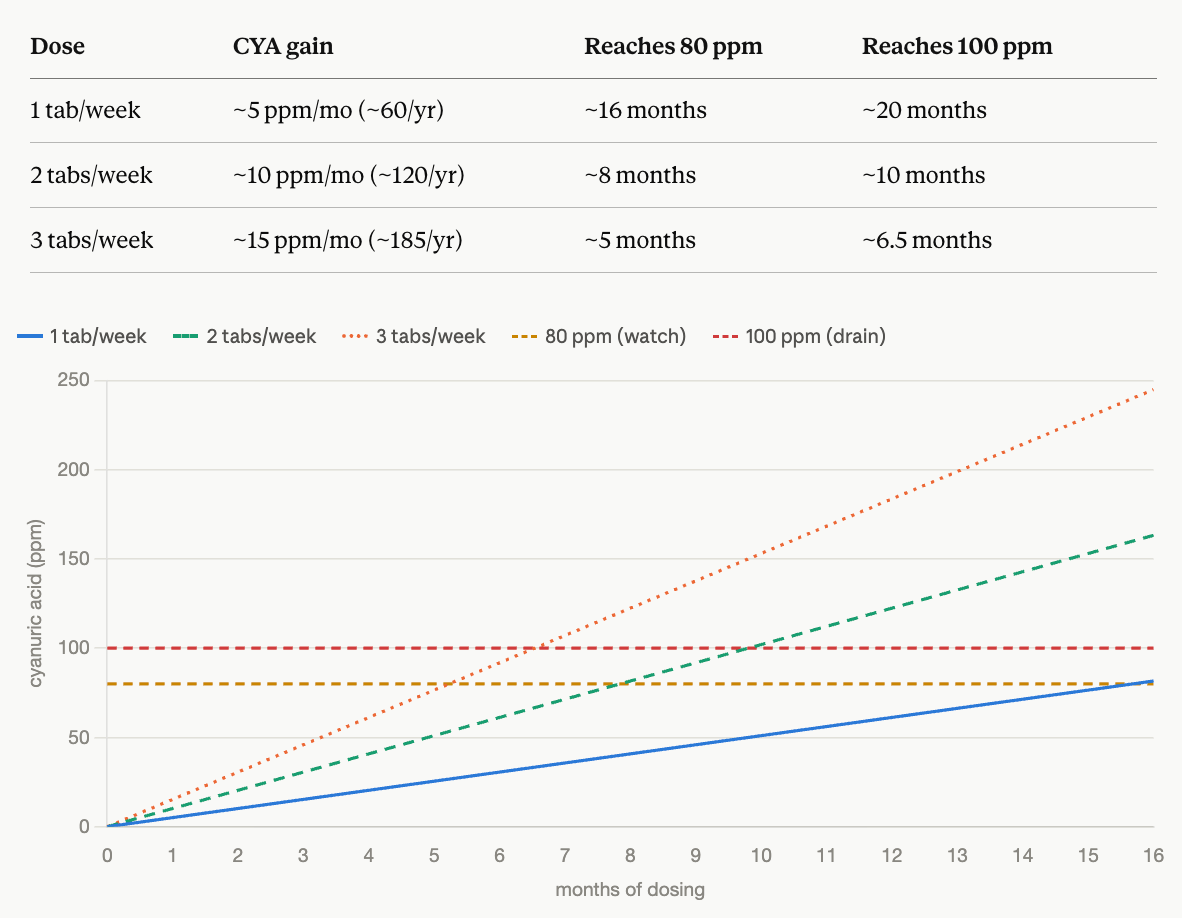
Same pool (28,000 gallons), same ~1.2 ppm of CYA per tab. The only thing changing is how many tabs go in each week, and it scales cleanly
And that's the predicament we all end up in
A little stabilizer is a good thing. You want your pool to measure between 20 and 80 ppm, ideally 30 to 50. It's sunscreen for your chlorine, and in our sun you want some. But when it climbs too high, that same sunscreen gets so thick your chlorine stops working. It's still floating around in the water, it just can't do its job of keeping things clean anymore.
That's when the pool goes cloudy, then green, seemingly out of nowhere, even though your chlorine reading looked fine. And here's the rub: once stabilizer is too high, there's no chemical you can pour in to fix it. The only real cure is dilution, draining part of the water and refilling with fresh, done in stages over a few weeks. It's slow, it's not cheap, and nobody enjoys it.
The Takeaway
We love Trichlor, but we also respect it. We use it on purpose, in the right amount, and we test your stabilizer on every single visit so we can catch it creeping up long before it becomes a problem. That way you get all the convenience of tablets with none of the summer-ending surprise.
Think of your pool chemistry like a blood test. If you don't disclose the medications, vitamins and supplements you take to your doctor, they might misdiagnose you based on your lab results. Same idea here. So if you ever decide to toss some tabs in yourself, no judgment, just shoot us a quick text so we can keep an accurate picture of what's in your water. That one heads-up saves everybody a whole lot of trouble.
Trichlor is a fantastic tool. Let's just keep it from becoming trouble.
