
How Long Should You Actually Run Your Pool Pump?
Everybody online says eight hours. Everybody online doesn't live in Pensacola.
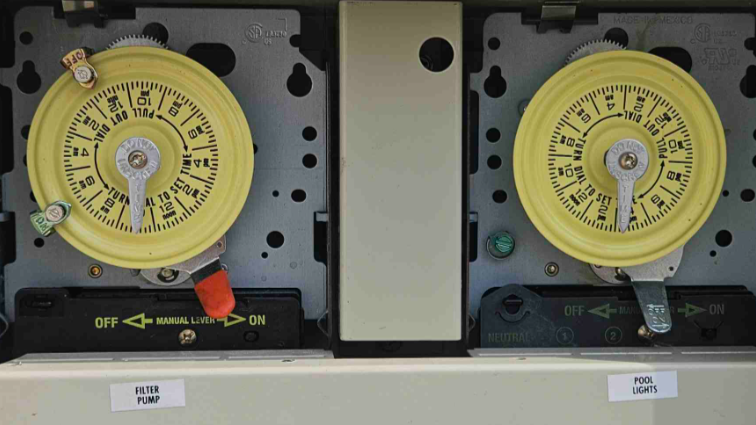
If you Google this, you'll get eight hours. You'll get it from about forty different websites, all saying the same thing with the same confidence.
That figure comes from national averages: pools in climates with real seasons, moderate sun, water that doesn't hit 90 degrees in August. Pensacola is not that.
We've got heat that starts in April and doesn't quit until October, UV that eats chlorine for breakfast, humidity that throws chemistry off between visits, and enough oak debris to keep a filter busy year-round.
So the honest answer for pools around here: twelve hours a day is your floor in season, not your ceiling.
What the Pump Is Actually Doing
Your pump has one job: move all the water in your pool through the filter. That's called turnover, and a healthy pool wants at least one full turnover a day. Two is better when the pool's working hard.
Water that isn't moving isn't being filtered, isn't being sanitized evenly, and isn't getting the chlorine distributed where it needs to go. Stagnant water is how you get algae blooming in a corner while your test strip says chlorine looks fine. The chlorine was fine, it just never made it over there.
Here's the part people miss. Chlorine only works where the water goes. You can dump every chemical in the world into a pool, but if the pump's only running eight hours in July, half of that pool is sitting still for two-thirds of the day.
Why Run It During the Day
This one's a little counterintuitive, because running at night is cheaper on some electric plans and it's the advice you'll hear from a neighbor.
But UV is the biggest thing burning off your chlorine, and UV happens in the daytime. Peak sun in the summer runs roughly 10am to 4pm, and that's exactly when your pool is losing sanitizer fastest and heating up fastest. That's when you want circulation happening, chlorine moving, water turning over, the filter pulling out whatever blew in.
Run at night and you're circulating clean water through a dark, cool pool while the real work goes undone during the hottest part of the day.
Rule of Thumb
Anchor your run time around peak sun. If you're running 12 hours, something like 9am to 9pm covers the whole UV window with room on both ends. If you're splitting into two cycles, make sure the bigger one lands mid-day.
A Runtime Schedule That Works Here
Variable-speed pumps should be run longer and at lower speeds. Counter-intuitively it spends less electricity running 16-24 hours low and slow, than a single-speed pump running eight. Low and slow is better filtration and a lower bill. It's the rare upgrade that actually pays for itself.
This is a starting point, not gospel. Your pool's size, your pump, your tree situation, and how many people are actually in the water all move these numbers.
Local Livin' Runtime Guide — Single-Speed Pump
June through September 12–14 hrs
April, May, October 10–12 hrs
November through March 6–8 hrs
Freeze nights Run continuously
Signs You're Not Running It Enough
Water looks slightly hazy or dull even though chemistry tests fine
Algae showing up in the same corner or on the steps, over and over
Debris settling on the bottom instead of getting picked up
You're chasing chlorine all week and can't seem to hold a level
Waterline scum ring building faster than it should
Any of those, add two hours before you add more chemical. A lot of "chemistry problems" are actually circulation problems wearing a disguise.
What About the Electric Bill
Fair concern. A single-speed pump running twelve-plus hours in August is not nothing on a power bill.
Two things worth weighing. First, running short and fighting algae all summer costs money too, in chemicals, in shock treatments, in a filter you're cleaning more often, and in the weekend you spent scrubbing instead of swimming. Second, if the bill is genuinely the problem, a variable-speed pump is the actual answer. It'll usually pay back the difference in a couple of seasons, and it'll run quieter while it does it.
One thing not to do: don't cut runtime and try to make up for it with extra chlorine. That's how you end up with a pool that's over-chlorinated in one spot, green in another, and burning through cyanuric acid stabilizer that you'll then have to dilute out. Circulation first, chemistry second.
The Short Version
Twelve hours minimum in season. Anchor it around mid-day sun. More if your pool's got heavy use, heavy shade, or heavy tree cover. Less in the dead of winter, but never zero. And if you've got a variable-speed pump, run it low and long.
If you're not sure what your pump is even set to (a lot of people aren't, especially if you bought the house with the pool already in it) that's a two-minute thing we can sort out on a visit. We'd rather set it right once than watch you fight it all summer.
Now go check your timer. We'll wait.
